
Industrial Robot Orders Pivot Beyond Automotive in 2026

The bottom line: For the first time, non-automotive buyers accounted for the majority of industrial robots ordered in North America, according to Q2 2026 data from the Association for Advancing Automation (A3). Automotive orders fell sharply while semiconductor, life sciences, and food manufacturing pulled the market forward.
The data and the timeframe
A3, the North American robotics trade group, reported 8,940 robots ordered in Q2 2026, up 4.3% in units and 21.3% in revenue (to $622 million) from a year earlier. For the first half of 2026, orders reached 17,995 units worth $1.166 billion, up 2.0% in units and 6.6% in value year over year. Collaborative robots made up 2,774 units and $114 million of that total, or roughly 15% of units ordered.
What's driving the shift
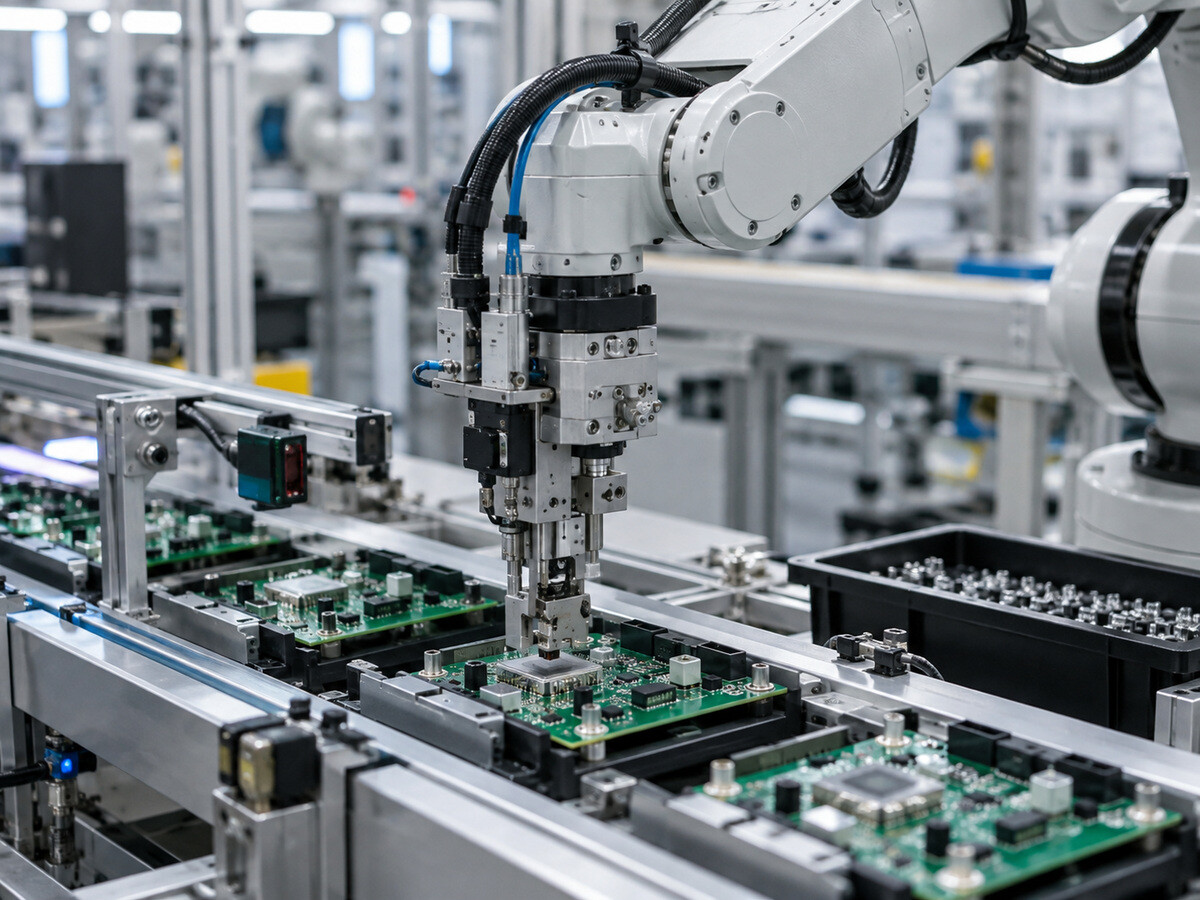
The headline number is the industry mix. Automotive OEM orders - long the anchor of North American robot demand - declined 25% in the first half of 2026. Every other major segment A3 tracks grew: semiconductor and electronics manufacturing rose 35%, life sciences and pharmaceuticals 32%, automotive components (a separate category from OEM assembly) 24%, and food and consumer goods 17%. Non-automotive customers accounted for 56% of units ordered in Q2, a threshold A3 highlighted as new.
Comparing to the longer trend
The shift sits inside a bigger structural story. The International Federation of Robotics' World Robotics 2025 report - the most recent full-year global census - found installations had more than doubled over the prior decade, with a global operational fleet of 4.66 million robots by the end of 2024. IFR's own outlook for 2026 points to the same underlying drivers now showing up in A3's order book: AI-enabled autonomy, IT/OT convergence, and early-stage humanoid deployment, all of which lower the barrier to automating non-automotive, higher-mix production lines that traditional robot cells were not built for.
Why it matters for industrial buyers and suppliers
For equipment makers, systems integrators, and component suppliers, the practical implication is that automotive is no longer the segment to watch for near-term demand. Chipmakers, contract electronics manufacturers, pharmaceutical and packaged-food producers are the segments now setting the pace of new orders - and collaborative robots, easier to redeploy across product lines, are capturing a growing share of that spending. Suppliers whose sales pipeline still assumes an automotive-led robotics market are working from an outdated picture.
Data limitations
A3's figures cover North American orders only; they do not capture Asian or European demand, where automotive automation remains larger relative to other sectors. The quarter-over-quarter industry breakdown reflects order bookings, not final shipments or installed base, and a single quarter's mix can move before it shows up in delivered units.
Takeaway
Robot demand growth in North America is no longer an automotive story. Suppliers and integrators positioning for 2026-2027 growth should track semiconductor, life sciences, and food/consumer segments as closely as they once tracked auto plants.
Sources
Association for Advancing Automation (A3), "Robot Orders Increase in Q2 as Automation Demand Broadens Across Industries," August 11, 2026. International Federation of Robotics (IFR), World Robotics 2025 report, September 25, 2025, and "Top 5 Global Robotics Trends 2026," January 8, 2026.