Red Sea Return Splits 2026 Container Freight Rates

Container shipping's return to the Red Sea and Suez Canal in 2026 is not producing a single, uniform trend in freight rates — it's splitting the market. Long-term contract rates on Asia-Europe lanes have fallen sharply toward pre-crisis 2023 levels, even as spot rates on transpacific lanes have simultaneously risen, driven by an entirely separate set of forces.
The data
- Long-term contract rates (Xeneta, data as of late January 2026): Far East–Mediterranean rates down 25% since end-2025 to $2,308 per FEU (40ft container); Far East–North Europe rates down 10% since end-2025 to $2,010 per FEU — both the lowest since the pre-crisis period in 2023.
- Spot rates (Drewry's World Container Index, data as of August 20, 2026): a composite global index of $4,526 per 40ft box, up 4% week-on-week. On transpacific lanes, Shanghai–Los Angeles stood at roughly $6,802/FEU (+9% week-on-week) and Shanghai–New York at roughly $9,507/FEU (+9%). On Asia-Europe lanes over the same week, Shanghai–Rotterdam eased 1% to about $4,401/FEU and Shanghai–Genoa eased 2% to about $4,955/FEU.
- Operationally, per carrier disclosures reported in September 2026, Maersk had restored only about one-third of its normal Suez/Red Sea transit volume, across 4 of its 13 relevant east-west services — a deliberately cautious pace intended to avoid renewed port congestion as vessels return to the shorter routing.

What's driving the divergence
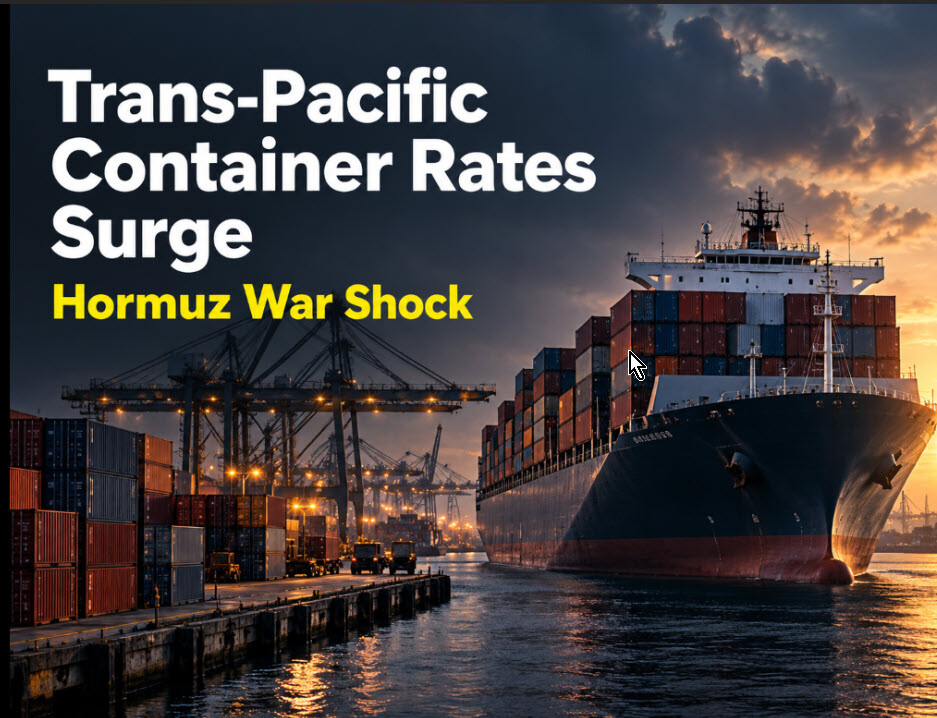
Two separate stories are unfolding at once. On Asia-Europe lanes, carriers are pricing long-term contracts to reflect anticipated overcapacity as vessels gradually shift back from the longer Cape of Good Hope diversion (in place since the Red Sea crisis began in late 2023) to the shorter Suez routing — and they are competing aggressively on committed volume ahead of that capacity actually returning. On transpacific lanes, the rate increase has nothing to do with the Red Sea: an extended peak season beyond the usual July window, blank sailings that trim available capacity, and new Panama Canal surcharges taking effect in September are the stated drivers.
A necessary comparison: contract rates vs. spot rates
It's important not to collapse "container freight rates" into one number. Xeneta's figures describe negotiated long-term contracts, which tend to move more slowly and reflect carriers' medium-term capacity expectations. Drewry's World Container Index reflects spot-market conditions, which react faster to short-term demand and capacity shifts. In 2026, these two measures are moving in different directions on different lanes at the same time — a genuine trend divergence rather than a single market recovering or worsening uniformly.
Industrial impact
For manufacturers and importers who rely on ocean freight for capital equipment, components, and finished goods, the practical implication is that shipment cost planning needs to separate contract-rate exposure (largely easing on Asia-Europe lanes) from spot-market exposure (still volatile, and rising on transpacific lanes for reasons unrelated to the Red Sea). Freight forwarders and logistics managers negotiating service contracts into 2027 are working against a backdrop of anticipated capacity growth once Suez transits normalize further — though that normalization itself remains incomplete.
Data limitations and uncertainty
Suez Canal traffic normalization is not complete, and its pace is uncertain: carriers have reversed prior announcements to expand Red Sea routing — CMA CGM, for instance, walked back an earlier plan to return three Asia-Europe services — reflecting continued caution about security conditions along the corridor. No source reviewed here establishes a confirmed date for full capacity restoration, so any forecast beyond current carrier guidance should be treated as provisional.
Practical takeaway
Buyers of ocean freight capacity should expect continued rate volatility that varies significantly by trade lane and by rate type (contract vs. spot) through the remainder of 2026, rather than a single uniform "freight costs are falling" or "rising" narrative.
Sources
- Xeneta — "Red Sea Return: What It Means for 2026 Container Shipping Contract Rates"
- BRF Logistics — "September 2026 Ocean Freight Outlook"
- Maritime Gateway — "Container Shipping Forecast 2026: Rates, Routes and Risks"