
Aluminum Prices Cool Sharply Through Mid-2026: What's Behind It

Aluminum Prices Cool Sharply Through Mid-2026: What's Behind It
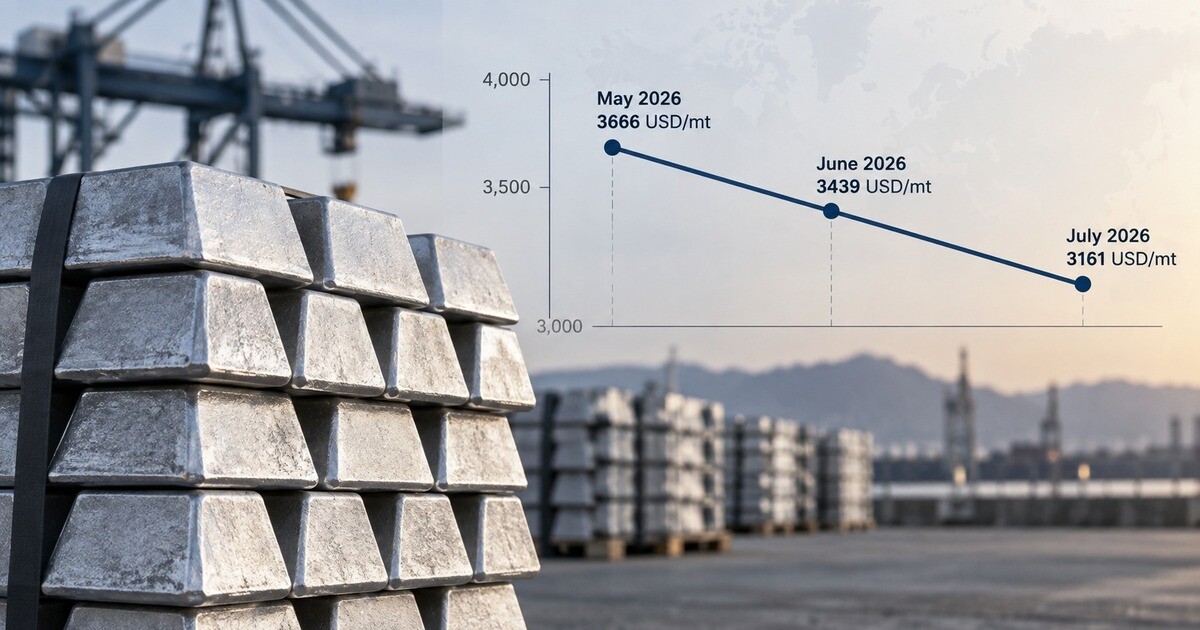
Global aluminum prices fell for three straight months through July 2026, according to the World Bank's monthly Commodity Markets data (the "Pink Sheet"). The move is large enough, and consistent enough across months, to count as a genuine trend rather than routine day-to-day volatility — and it lands at the same time some analysts were still forecasting the opposite direction for the year.
The data and the time frame
Per the World Bank's August 2026 Commodity Markets release, average monthly aluminum prices moved as follows: May 2026 at $3,666 per metric ton, June 2026 at $3,439/mt, and July 2026 at $3,161/mt — a cumulative decline of about 13.8% in two months from the May peak. Iron ore softened over the same window (May $108.6/dmt, June $100.8/dmt, July $98.2/dmt, roughly a 9.6% two-month decline), suggesting the pressure on aluminum is not happening in isolation from the broader industrial metals complex, though the two markets are driven by different supply fundamentals.
What's driving the pullback
A specialist metals-market report on China's aluminum extrusion sector (Mysteel, published July 7, 2026) points to a concrete, dated mechanism behind at least part of the softness: domestic extrusion capacity utilization in China fell to a cyclical low of 37.05%, order books shortened from 10–15 days to 8–10 days, and both raw-material and finished-goods inventories declined by roughly 15% as producers cut output rather than accumulate unsold stock. The report describes this as "passive destocking driven by production cuts rather than an improvement in terminal demand" — i.e., producers are pulling back because buyers aren't showing up, not because the market is clearing. It also flags that restrictions on aluminum ingot and aluminum-product export policies are limiting China's ability to offload domestic oversupply into export markets, which would otherwise cushion the domestic price impact.
Where this cuts against other forecasts
The decline sits awkwardly next to a structural bull case some analysts were making for 2026 aluminum. A widely cited December 2025 forecast argued for an approximate 200-kilotonne global supply deficit this year, driven by China holding output near its self-imposed 45-million-tonne capacity cap, non-Chinese smelters struggling to secure competitively priced power as AI data centers reportedly bid electricity prices toward $115/MWh versus the roughly $40/MWh smelters need, and a prolonged outage at an Icelandic smelter. That forecast projected 2026 average prices near $2,900/t with "further upside" risk. Prices through July — even after the recent decline — remain well above that $2,900 reference point, so the July data does not confirm the deficit thesis has failed; it is equally possible that prices are normalizing down from an elevated first-half level toward a tighter fundamental range, rather than signaling a structural surplus. The two pictures — a demand-driven near-term Chinese glut and a supply-driven medium-term global deficit case — are not necessarily contradictory, but they have not yet been reconciled by the available data, and this piece does not attempt to resolve that tension.
Why it matters for industrial buyers
For manufacturers who buy aluminum as an input — extrusions, cable, automotive and appliance components, packaging — a sustained multi-month price pullback is a real opportunity to revisit hedging and procurement timing, but the conflicting medium-term supply signals argue against assuming the lower price level is durable. Buyers with flexibility on order timing may want to watch the next one or two Pink Sheet releases before locking in long-term supply contracts at the current lower price, since the same reports that explain today's softness also describe supply-side constraints that have not gone away.
Data limitations
The World Bank figures are monthly averages, not daily spot prices, so they smooth over shorter-term swings (including any driven by unrelated short-term events later in the same window). The Mysteel data is specific to China's extrusion segment and is a plausible contributor to, not a complete explanation of, the global average price move. This piece does not incorporate August or September 2026 price action, which was not yet reflected in the August Pink Sheet release used here.
Sources
- World Bank — Commodity Markets ("Pink Sheet"), August 2026 release
- Mysteel — China aluminum extrusion capacity utilization report, July 7, 2026
- ING Think — "Aluminium deficit will support prices in 2026," December 8, 2025