
Foxconn AI Server Revenue Tops Half for First Time

Foxconn's manufacturing empire has quietly flipped: for the first time, the world's largest contract electronics maker now earns more from building AI servers and networking gear than from assembling the smartphones that made it famous.
Hon Hai Technology Group, known globally as Foxconn, reported August 2026 revenue of NT$921.8 billion (about $29.1 billion), up 52% from a year earlier and a record for the month. Combined with July's NT$946.5 billion — itself a record and up 54.2% year-on-year — the company's first two months of the third quarter totaled NT$1,868.3 billion, comfortably ahead of the roughly NT$837 billion monthly average it posted in the second quarter. Cloud and networking products, the segment that includes AI server racks, accounted for 51% of revenue in the period, the first time that category has exceeded half of total sales, pushing smartphone assembly, at 29%, into second place. Management told investors operations should "gradually gain momentum" through the rest of the quarter, and shares rose 3.4% on the guidance.
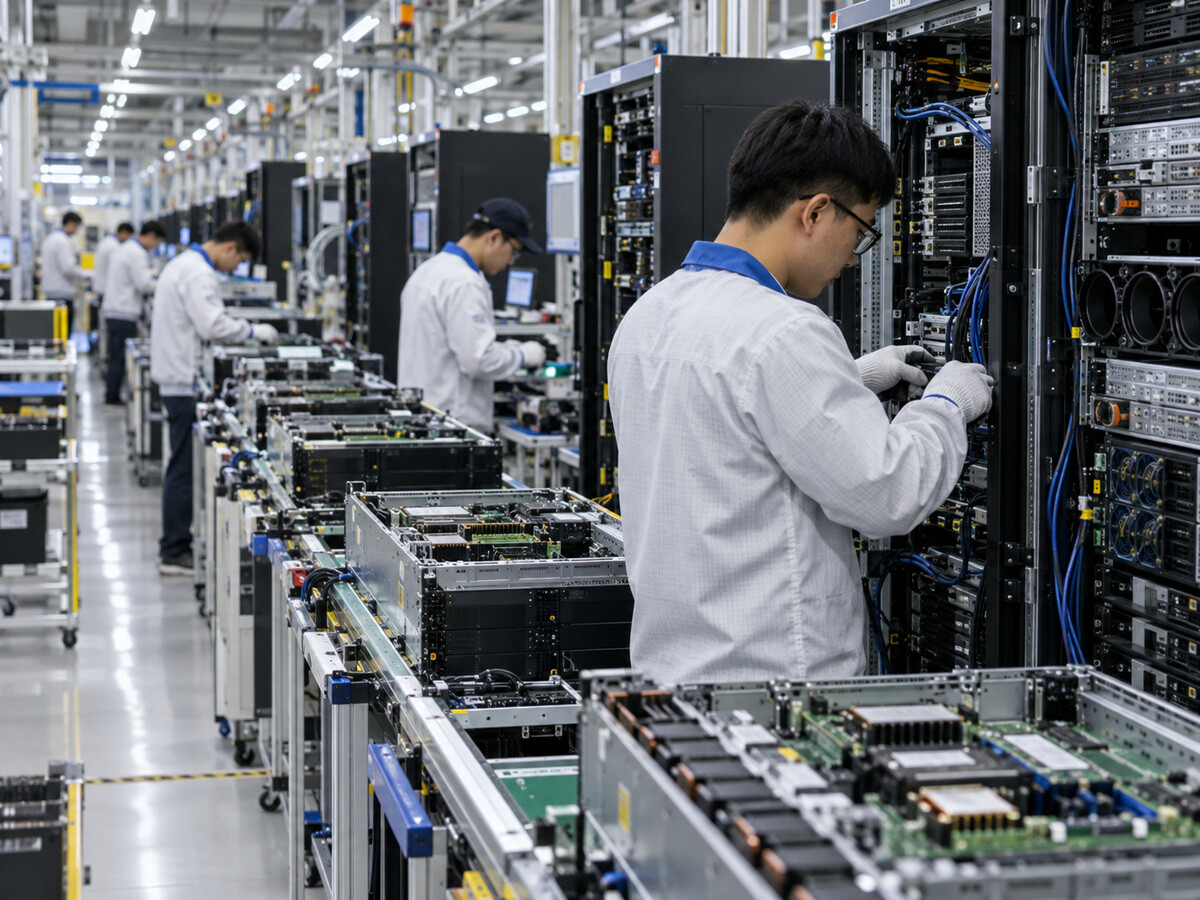
The growth beat analyst expectations, which had priced in roughly 37% revenue growth for the July-September quarter. The driver is not new — Foxconn is Nvidia's principal server-assembly partner and one of the biggest beneficiaries of the global buildout of AI data centers — but the scale of the shift is. Google, Amazon, Meta, Microsoft, Oracle, ByteDance, Tencent, Alibaba and Baidu are together expected to spend more than $886.7 billion on capital projects in 2026, roughly 90% more than a year earlier, with North American hyperscalers accounting for close to 90% of that spending. Foxconn is now structurally positioned as one of the main physical assemblers of that capital-spending wave.
For the broader electronics manufacturing industry, the shift matters because it reallocates scarce capacity. Foxconn management has flagged that procurement pressure is spreading beyond GPUs themselves into advanced chip packaging, high-bandwidth memory and networking components — the same component pool that feeds industrial computing, telecom and automation equipment. Rack-level AI server shipments are projected to grow by a "high double-digit percentage" in the third quarter and more than double for the full year, keeping upward pressure on the memory, packaging and networking-component supply that other electronics categories compete for.
Two risks sit underneath the headline growth. Foxconn's own disclosures point to its share of the high-end AI server rack market slipping to roughly 39% in 2026 from about 51% in 2025, as rivals such as Quanta and Wistron win a larger share of hyperscaler orders. Advanced packaging capacity, rather than GPU supply itself, is emerging as the constraint most likely to cap growth in 2027.
The takeaway for global industrial supply chains is straightforward: as long as hyperscaler capital spending keeps climbing, contract manufacturers will keep shifting production capacity, engineering talent and component allocation toward AI infrastructure — and away from other categories of electronics that draw on the same memory, packaging and networking inputs. Companies that depend on general-purpose computing hardware, industrial control systems or networking equipment should expect continued competition for component allocation as this shift plays out.
What to watch next: Foxconn's full third-quarter results, expected in mid-November; further guidance on 2027 packaging-capacity additions; and whether rivals' gains in the high-end rack segment continue to erode Foxconn's market share.
Sources: Digitimes, TechRepublic, ProgressiveRobot, NewsBytesApp